Filaments are dominated by dark matter and contain galaxies plus thin, warm-to-hot gas that can be difficult to observe directly.
Look for: an elongated bridge linking two denser knots.THE OBSERVABLE UNIVERSEINTERACTIVE OPEN ATLAS · 13.8 BILLION YEARS
A VISUAL GUIDE TO THE LARGEST STRUCTURE IN NATURE
The cosmic
web
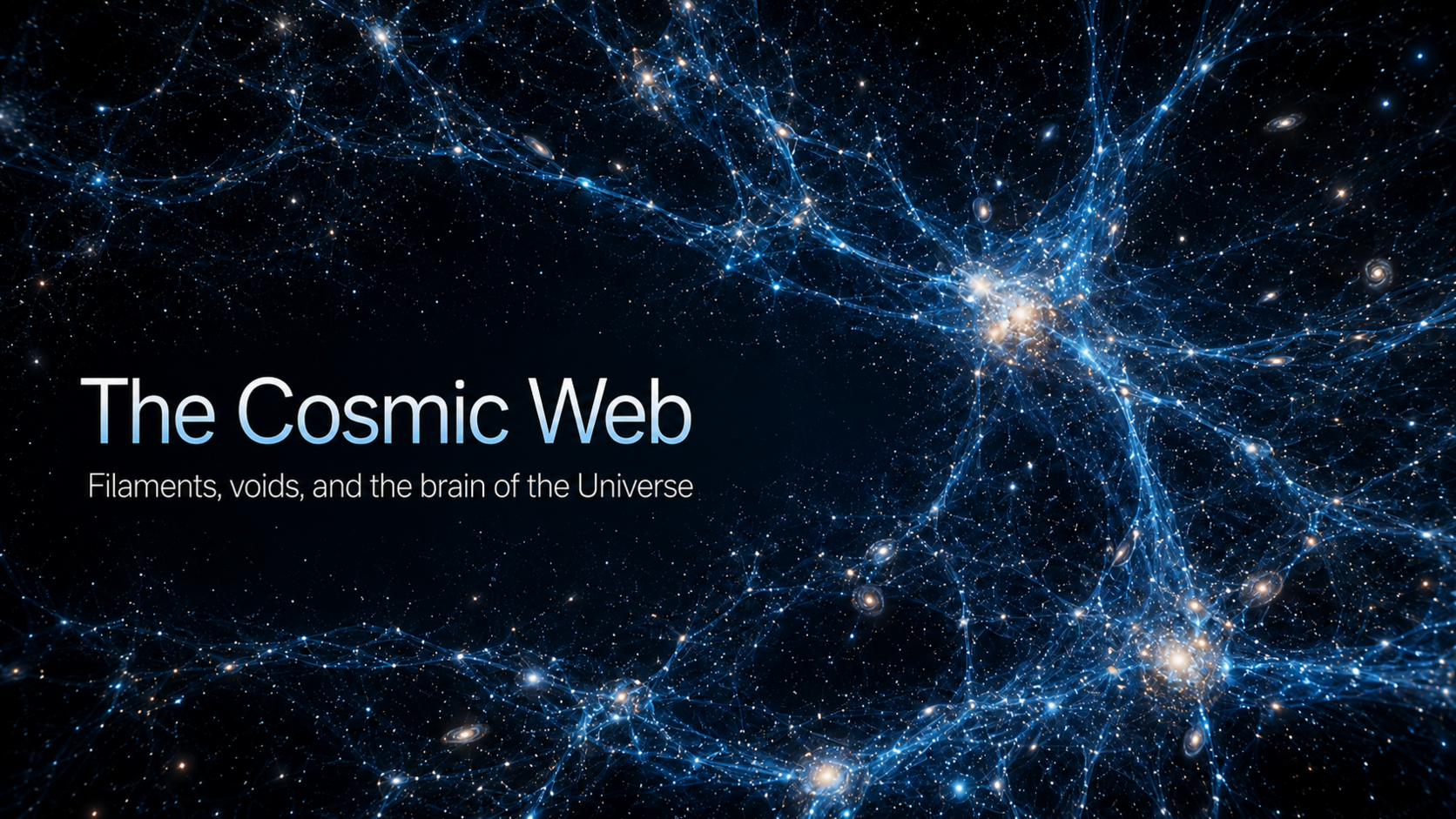
Galaxies are not scattered at random. They trace an invisible framework of dark matter, filaments, walls, clusters, and enormous voids.
SELECT ANY NODE
NODE 05 / MASS MAPRICH CLUSTER
The busiest intersection: hot gas, dark matter, and many galaxies.
5 mapped connections in this simplified networkMass map: the broad gravitational scaffold is emphasized.
TYPICAL FILAMENT SCALE10–100+million light-years
ORDINARY MATTER≈ 5%of the cosmic energy budget
WHIM TEMPERATURE10⁵–10⁷ Khot, yet extremely diffuse
01 / ANATOMY OF THE WEB
Not a thread, but
a gravitational landscape.
The cosmic web has no solid surface. It is a three-dimensional pattern in the distribution of matter. Choose a structure below to reveal how it behaves.
02 / HOW IT FORMED
13.8
BILLION YEARS OF GROWTHGravity amplified differences that were almost imperceptible.
In the early Universe, matter was distributed nearly evenly. Regions with slightly more mass exerted slightly stronger gravity. Over time, dark matter and gas collapsed into sheets and filaments, while dense nodes emerged where matter streams met.
TINY FLUCTUATION→WALL→FILAMENT→NODE
03 / EVOLUTION OF THE WEB
Turn the cosmic
clock.
Select an epoch to follow tiny early variations as gravity grows them into the largest known pattern in nature.
The web today
The observable Universe contains a vast foam-like pattern of nodes, filaments, walls, and voids.
Snapshot: large-scale structure
5 / 5
04 / WHAT THE UNIVERSE CONTAINS
APPROXIMATE COSMIC ENERGY BUDGET
What you see is
only about 4.9%.
Planck’s widely used cosmic recipe gives 4.9% ordinary matter, 26.8% dark matter, and 68.3% dark energy. These are model-dependent estimates, not pieces counted directly.
CHECK THE ESA / PLANCK SOURCE ↗Dark matter
It does not emit light, but its gravity builds the main scaffolding in which galaxies and hot gas collect.
05 / MODEL CHECK
COMMON MISCONCEPTIONS
What the glowing
pictures hide.
Most cosmic-web images are maps or simulations with enhanced color. The diffuse gas and dark matter are generally invisible to human eyes.
06 / EXPERIENCE THE SCALE
100 millionlight-years
GALAXYGROUPFILAMENTUNIVERSE
SCALE 3/4
A large filament
A chain of groups and clusters can stretch between immense cosmic voids.
07 / IS THE UNIVERSE A BRAIN?
THE SHORT ANSWER
Does it look like one? Yes.
Does that prove it thinks? No.
Networks solve similar geometry
Neurons and galaxies both appear as nodes joined by connections. Branching networks also occur in rivers, roots, mycelium, and blood vessels because network shapes can emerge from growth, flow, and constraint.
Different physics, scale, and function
Neurons transmit electrochemical signals and change connections rapidly. The cosmic web forms through gravity over billions of years. No evidence shows memory, metabolism, or thought processing in the web.
A RULE OF SCIENCE
A fascinating resemblance becomes a scientific hypothesis only when it makes a testable prediction.
08 / HOW ASTRONOMERS KNOW
We cannot photograph the entire web from outside. We reconstruct it.
Independent methods reveal different parts of the same structure. Open the primary sources for deeper reading.
01GALAXY REDSHIFT MAPS
Positions and distances turn points of light into a three-dimensional distribution.
NASA ↗02GRAVITATIONAL LENSINGThe bending of background light reveals mass, including invisible dark matter.
NASA ↗03HOT INTERGALACTIC GASX-ray and ultraviolet observations help trace diffuse matter between clusters.
ESA ↗04EARLY-UNIVERSE LIGHTThe microwave background records the initial variations from which structure grew.
ESA / PLANCK ↗05EUCLID DEEP FIELDSWide, sharp surveys reveal galaxy clustering and help trace the web across cosmic time.
ESA / EUCLID · 2025 ↗FROM TELESCOPE TO MAP
- 1Measure sky position and redshift
- 2Estimate distance and reconstruct a 3D distribution
- 3Compare galaxy, gas, and lensing signals
- 4Test the pattern against simulations
QUICK ANSWERS
Four questions
people ask first.
Short answers for learners, families, and teachers. Open a question to reveal the explanation.
What is the cosmic web?
The largest-scale pattern in the known Universe: galaxies, gas, and dark matter arranged into nodes, filaments, walls, and vast underdense voids.
Can we see the cosmic web directly?
Not as one complete photograph. Astronomers reconstruct it from galaxy positions and redshifts, gravitational lensing, diffuse-gas observations, and simulations.
What holds the cosmic web together?
Gravity shapes the web. Dark matter supplies most of the gravitating matter scaffold, while ordinary matter falls into the same large-scale structure.
Is the cosmic web alive or conscious?
There is no scientific evidence that it is. Its visual similarity to neural networks does not demonstrate shared physics, information processing, or consciousness.
09 / FIELD CHECK
Can you read
the web?
Choose one answer for each question, then check your result. Every explanation stays free and visible.
Answer all six questions to reveal your score.
10 / COSMIC DICTIONARY
Search the
language of structure.
18 terms shown
Baryonic matterMatter
Ordinary matter made of particles such as protons and neutrons.
ClusterStructure
A gravitationally bound collection of hundreds or thousands of galaxies.
Cosmic microwave backgroundEvidence
Ancient light released about 380,000 years after the Big Bang.
Dark energyMatter
The name given to the unknown cause associated with accelerated cosmic expansion.
Dark matterMatter
Invisible matter inferred from its gravitational effects.
FilamentStructure
An elongated bridge of dark matter, galaxies, and diffuse gas.
Galaxy biasEvidence
The fact that visible galaxies trace the underlying matter distribution imperfectly.
Gravitational lensingEvidence
The bending of light by mass; weak lensing can map dark-matter distributions statistically.
HaloStructure
A gravitationally bound concentration of dark matter in which galaxies and clusters form.
MegaparsecScale
A distance of one million parsecs, equal to about 3.26 million light-years.
NodeStructure
A dense intersection where several filaments meet.
RedshiftEvidence
The stretching of light toward longer wavelengths, used to help map cosmic distance and expansion.
SimulationEvidence
A numerical model that evolves matter and energy under physical rules and chosen assumptions.
SuperclusterStructure
A vast association of galaxy groups and clusters that is not necessarily gravitationally bound as one object.
VoidStructure
A vast region with much less matter than the cosmic average.
WallStructure
A broad sheet-like arrangement of galaxies between voids.
WHIMMatter
Warm–hot intergalactic medium: extremely diffuse gas at roughly 100,000 to 10 million kelvin.
Light-yearScale
The distance light travels in one year, about 9.46 trillion kilometres.
FREE DATA LAB / OPEN TO EVERYONE
Carry the lesson
beyond the page.
READ · INSPECT · COMPARE · SOLVE
Four short activities turn the atlas into a hands-on astronomy lesson. No account or personal information is required.
0 of 4 missions completed and saved on this device.Map the architecture of the Universe
Cosmic Web Core
READIllustrated field notes
INSPECTSmall reusable dataset
COMPAREObservation clues
SOLVEInteractive mission
WHAT YOU WILL EXPLORE
- Nodes, walls, filaments, and voids
- A compact structure dataset
- A guided network-mapping activity
YOUR MISSION
Trace the shortest matter-flow route from a wall to a galaxy cluster.
Everything in this learning lab is free. Progress stays only in this browser; no account or personal data is sent.
THE OBSERVER'S VAULT / OPEN ACCESSFour missions.
Four missions.
One connected field course.
01SCIENCE FIRST
Explanations clearly separate evidence, models, and speculation.
02LEARN BY DOING
Every capsule includes a small question or observation task.
03OPEN ACCESS
The atlas and all activities are free for students, families, and clubs.
FREE COSMIC ATLAS COLLECTION
One universe. Five interactive experiences.
Continue through the connected astronomy labs, or share this free atlas with a classmate, teacher, family member, or another curious mind.